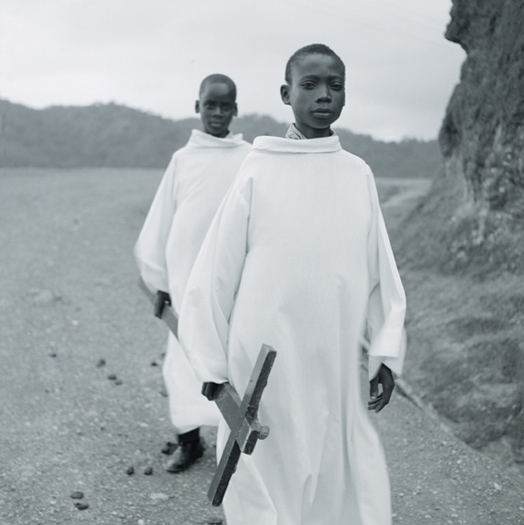
LEAH GORDON
(b. 1959 Ellesmere Port)
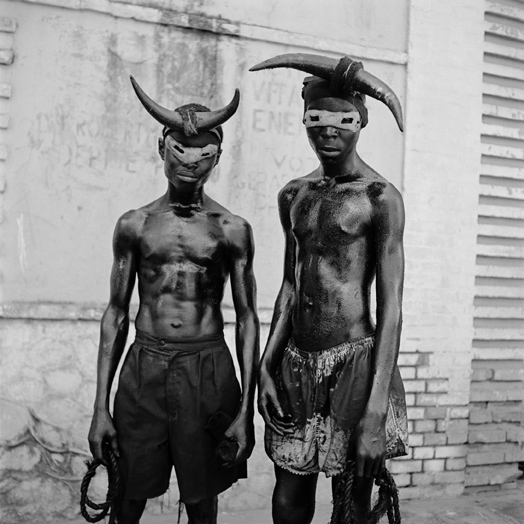
Leah Gordon's CASTE photographic project and her films, 'Bounda pa Bounda': A Drag Zaka & Atis Rezistans: The Sculptors of Grand Rue are being exhibited as part of 'Taboo',
curated by Brook Andrew at the MUSEUM OF CONTEMPORARY ART, SYDNEY until 24 February 2013
www.mca.com.au/
In February 2013 Gordon’s 'Kanaval': Vodou, Politics and Revolution on the Streets of Haiti photographs will open at PIH, Montreal.
http://phi-centre.com/
Her film 'Atis Rezistans': The Sculptors of Grand Rue and a selection of her photography is being exhibited in the galleries of the Fowler Museum, Los Angeles as part of the In Extremis show until Jan 20 2013.
http://www.fowler.ucla.edu/exhibitions/extremis-death-and-life-21st-century-haitian-art
For more information on LEAH GORDON please call 07794-629-188
www.mca.com.au/
In February 2013 Gordon’s 'Kanaval': Vodou, Politics and Revolution on the Streets of Haiti photographs will open at PIH, Montreal.
http://phi-centre.com/
Her film 'Atis Rezistans': The Sculptors of Grand Rue and a selection of her photography is being exhibited in the galleries of the Fowler Museum, Los Angeles as part of the In Extremis show until Jan 20 2013.
http://www.fowler.ucla.edu/exhibitions/extremis-death-and-life-21st-century-haitian-art
For more information on LEAH GORDON please call 07794-629-188
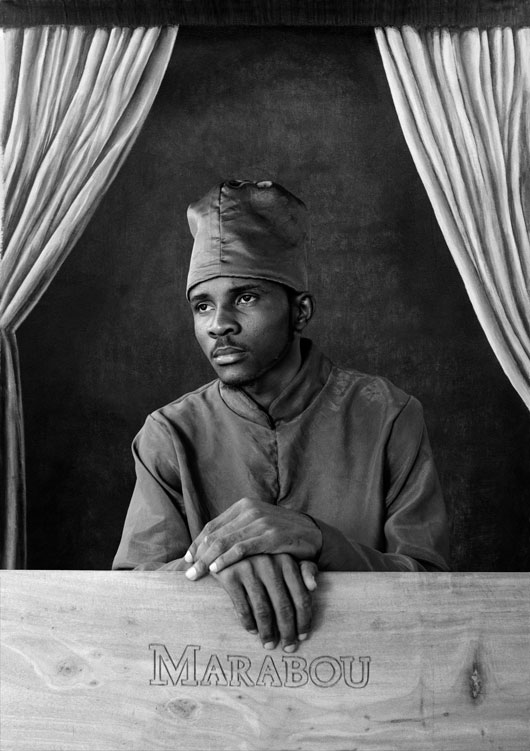
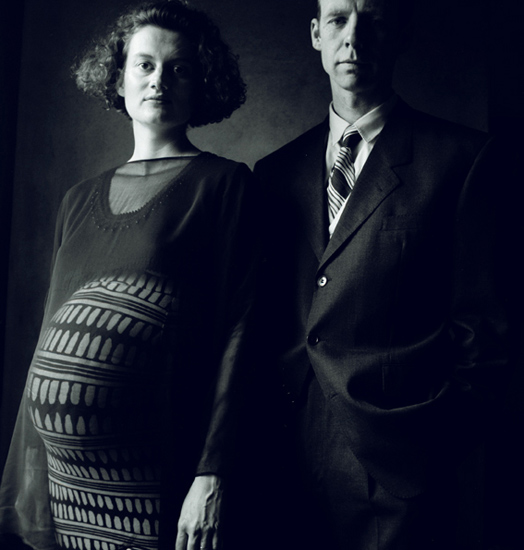
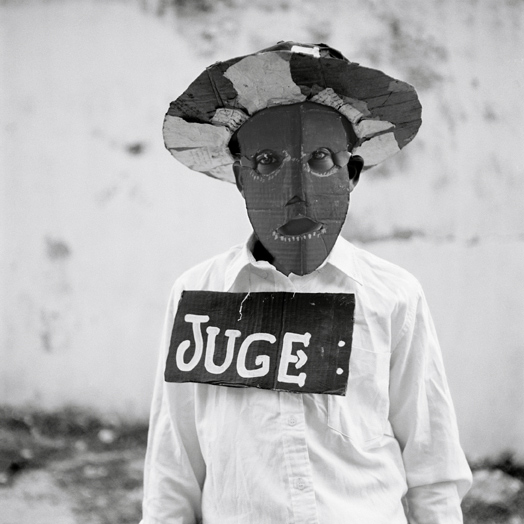
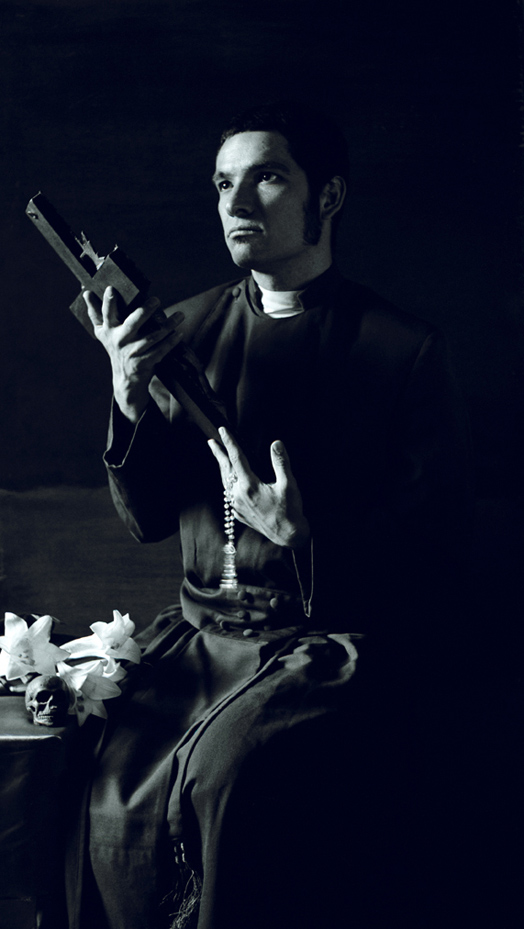
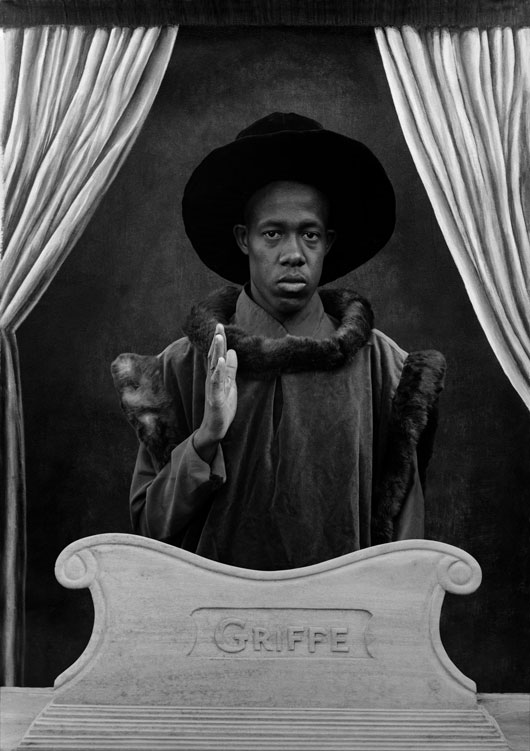
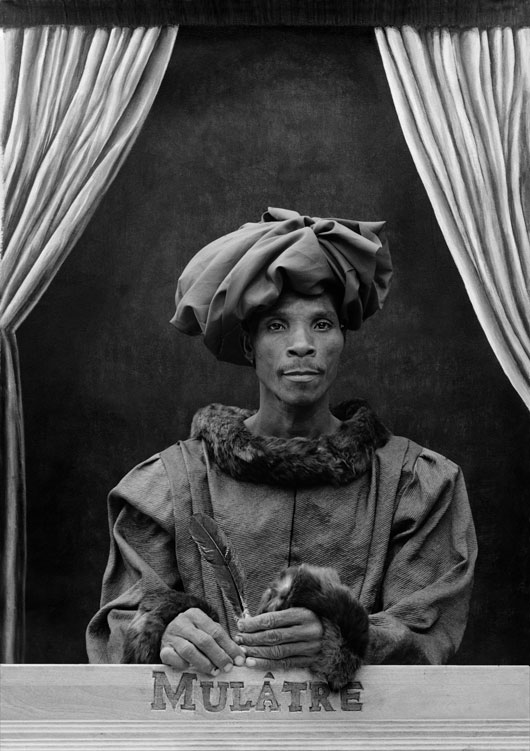
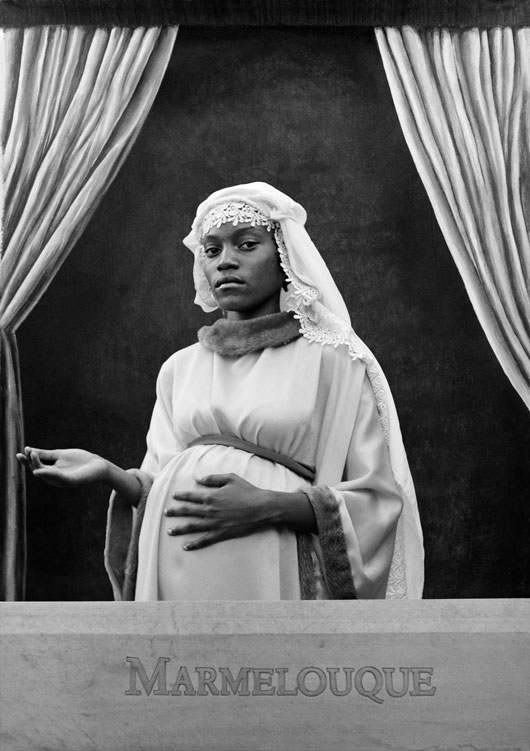
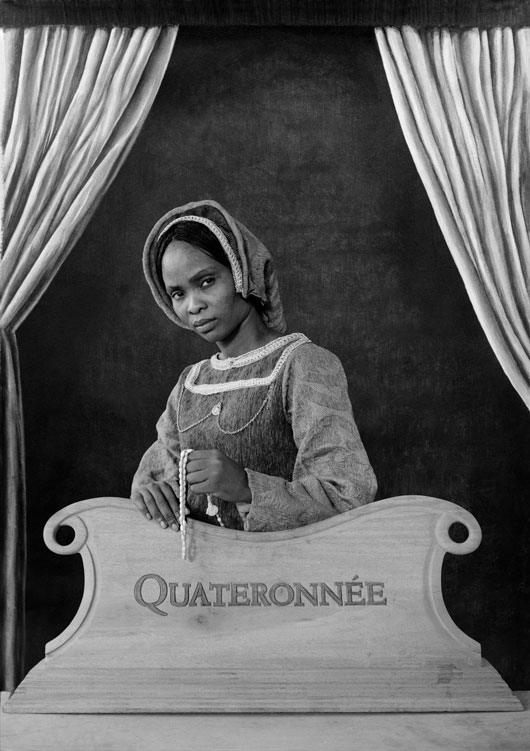
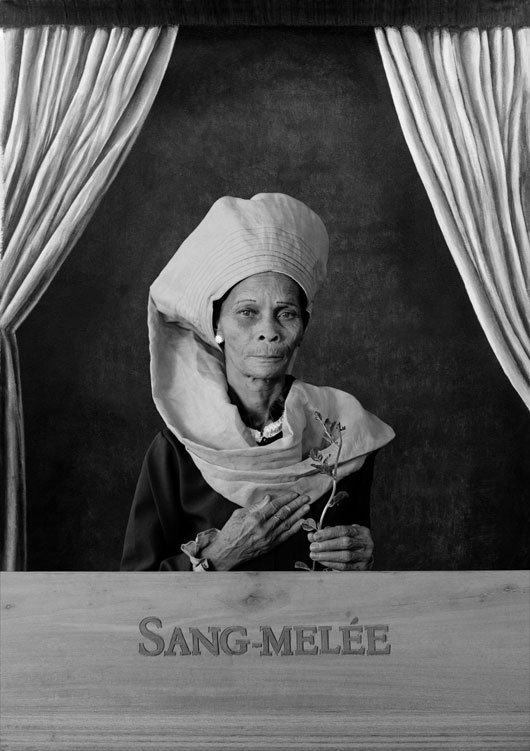
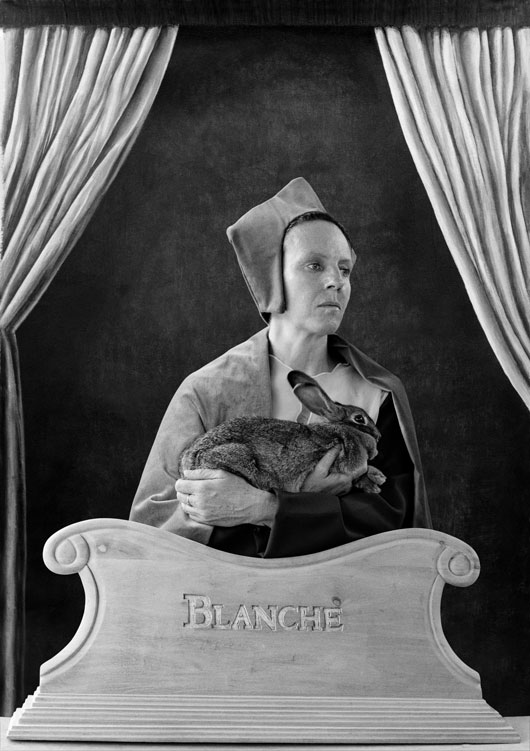
Leah Gordon's new photographs investigate the practice of the grading from black to white of skin colour, referred to as Caste, which revealed the extent of racial mixing in 18th century colonial Haiti.
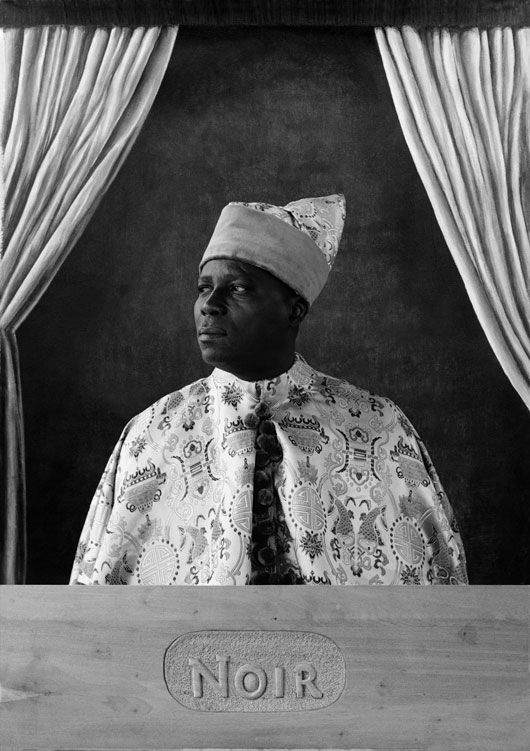
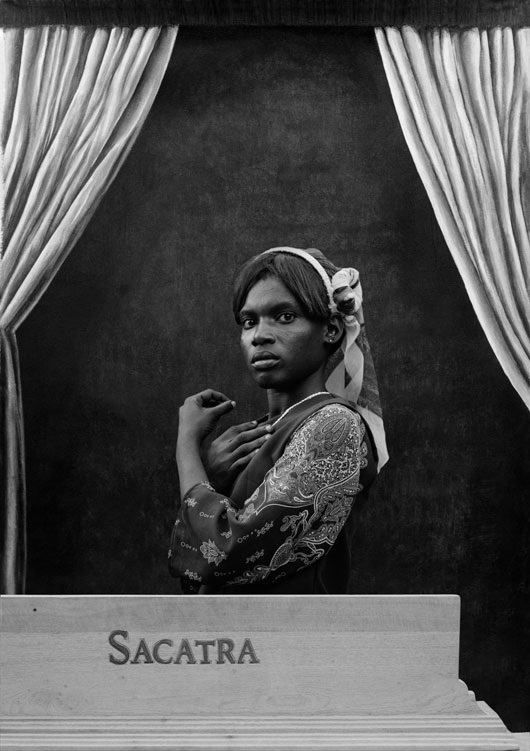
A measuring system which moves through black to white in nine degrees, it was developed by a French colonialist living in Haiti during the slave plantation period. Moreau de St. Mery created a surreal taxonomy of race which classified the skin colour of the indigenous population, where white, or 'Blanche' was inevitably socially superior to black, or 'Noir'. There are nine degrees of shading in all, from pure black to 1/8 white, and 7/8 black and so on through 'Sacatra', 'Griffe', 'Marabou', 'Mulâtre', 'Mamelouque', 'Quarteronné' and 'Sang-Mêlé' to 'White'. As Colin Dayan, a Haitian historian, comments, 'Stranger than any supernatural fiction, the radical irrationality of Moreau St Mery’s methods demonstrates to what lengths the imagination can go if driven by racial prejudice.'
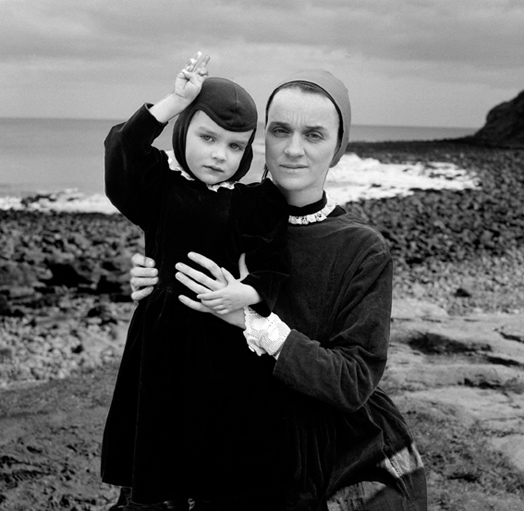
Gordon's discovery of Moreau's classification system inspired her to make Caste Portraits of the nine skin varieties, with herself at one end of the scale, the 'Blanche', and her partner, Andre Eugene, a Haitian sculptor, at the other end of the racial spectrum.
The images reference celebrated Renaissance portraits, styled so that they closely resemble, but don't completely mimic, works such as Bellini's Doge Loredan (Noir), The Betrothal of the Arnolfini by Jan Van Eyck and Holbein's Lady with a Squirrel (Blanche). Gordon found her models in the Grand Rue area of Port-au-Prince, home to the artists' collective Atis Rezistans. She worked with local craftsmen to make the costumes for the sitters and wooden plaques behind which the models stand, bearing the identifying names of the caste colours. There is a double impact here, both in the unexpectedness of seeing a black face in these familiar portraits and in seeing the dignity with which the sitters bear their signifying labels.
The series is one of Gordon's many investigations into the role she plays in Haitian history, a country where she has been working as a photographer, filmmaker and curator for the last twenty years. Growing up in Ellesmere Port, Liverpool, her origins were at the geographical meeting point of the slave trade and the industrial revolution. The abolition of the Slave Trade in Great Britain, in 1807, coincided with the loss of workers' rights in northern England. It appears that the same group of Manchester Industrialists campaigned for both losses. Leah Gordon's ancestors were the peasantry near Manchester who became, because of the industrial revolution, the northern working-class. The Caste Portraits reveal that what separates us also connects us: the colour classification system, rather than excluding Gordon, is ironically one of the few things that places her firmly in the picture.
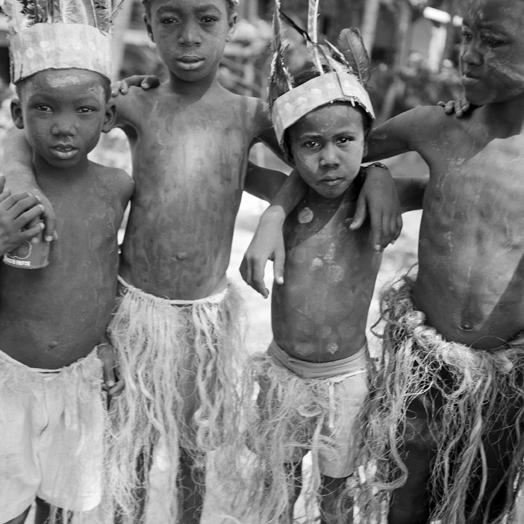
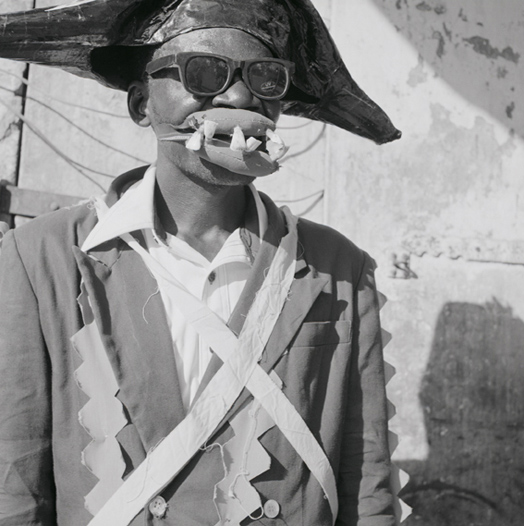
Leah Gordon is a photographer, film-maker and curator who has produced a body of work on the representational boundaries between art, religion, anthropology, post-colonialism and folk history. Her photography book Kanaval: Vodou, Politics and Revolution on the Streets of Haiti was published in June 2010 and was the culmination of a sixteen year long project. In the twenty years that she has been working as a curator/artist in Haiti, she has produced a number of films including 'Bounda pa Bounda', about a cross-dressing Vodou priest and 'Atis Rezistans: the Sculptors of Grand Rue', about the artists collective in Port-au-Prince.
Gordon was the adjunct curator for the Haitian Pavilion at the 54th Venice Biennale in 2011, is part of the curatorial team for the upcoming In Extremis exhibition of Haitian Vodou arts (opening in Sept 2012) at the Fowler Museum, UCLA and is co-curating, with Alex Farquharson, the major exhibition Kafou, on Haitian art, Vodou and the Revolutionary History at Nottingham Contemporary in October 2012. Gordon is represented by Riflemaker, London.
A measuring system which moves through black to white in nine degrees, it was developed by a French colonialist living in Haiti during the slave plantation period. Moreau de St. Mery created a surreal taxonomy of race which classified the skin colour of the indigenous population, where white, or 'Blanche' was inevitably socially superior to black, or 'Noir'. There are nine degrees of shading in all, from pure black to 1/8 white, and 7/8 black and so on through 'Sacatra', 'Griffe', 'Marabou', 'Mulâtre', 'Mamelouque', 'Quarteronné' and 'Sang-Mêlé' to 'White'. As Colin Dayan, a Haitian historian, comments, 'Stranger than any supernatural fiction, the radical irrationality of Moreau St Mery’s methods demonstrates to what lengths the imagination can go if driven by racial prejudice.'
Gordon's discovery of Moreau's classification system inspired her to make Caste Portraits of the nine skin varieties, with herself at one end of the scale, the 'Blanche', and her partner, Andre Eugene, a Haitian sculptor, at the other end of the racial spectrum.
The images reference celebrated Renaissance portraits, styled so that they closely resemble, but don't completely mimic, works such as Bellini's Doge Loredan (Noir), The Betrothal of the Arnolfini by Jan Van Eyck and Holbein's Lady with a Squirrel (Blanche). Gordon found her models in the Grand Rue area of Port-au-Prince, home to the artists' collective Atis Rezistans. She worked with local craftsmen to make the costumes for the sitters and wooden plaques behind which the models stand, bearing the identifying names of the caste colours. There is a double impact here, both in the unexpectedness of seeing a black face in these familiar portraits and in seeing the dignity with which the sitters bear their signifying labels.
The series is one of Gordon's many investigations into the role she plays in Haitian history, a country where she has been working as a photographer, filmmaker and curator for the last twenty years. Growing up in Ellesmere Port, Liverpool, her origins were at the geographical meeting point of the slave trade and the industrial revolution. The abolition of the Slave Trade in Great Britain, in 1807, coincided with the loss of workers' rights in northern England. It appears that the same group of Manchester Industrialists campaigned for both losses. Leah Gordon's ancestors were the peasantry near Manchester who became, because of the industrial revolution, the northern working-class. The Caste Portraits reveal that what separates us also connects us: the colour classification system, rather than excluding Gordon, is ironically one of the few things that places her firmly in the picture.
Leah Gordon is a photographer, film-maker and curator who has produced a body of work on the representational boundaries between art, religion, anthropology, post-colonialism and folk history. Her photography book Kanaval: Vodou, Politics and Revolution on the Streets of Haiti was published in June 2010 and was the culmination of a sixteen year long project. In the twenty years that she has been working as a curator/artist in Haiti, she has produced a number of films including 'Bounda pa Bounda', about a cross-dressing Vodou priest and 'Atis Rezistans: the Sculptors of Grand Rue', about the artists collective in Port-au-Prince.
Gordon was the adjunct curator for the Haitian Pavilion at the 54th Venice Biennale in 2011, is part of the curatorial team for the upcoming In Extremis exhibition of Haitian Vodou arts (opening in Sept 2012) at the Fowler Museum, UCLA and is co-curating, with Alex Farquharson, the major exhibition Kafou, on Haitian art, Vodou and the Revolutionary History at Nottingham Contemporary in October 2012. Gordon is represented by Riflemaker, London.
LEAH GORDON is the adjunct curator of the Haitian Pavilion at this year's VENICE BIENNALE
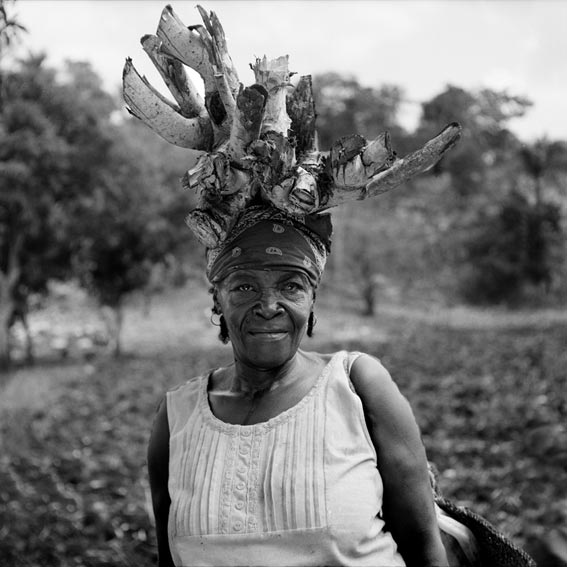
'Kanpe' (platinum print)
100 x 100 cm, 2011
100 x 100 cm, 2011
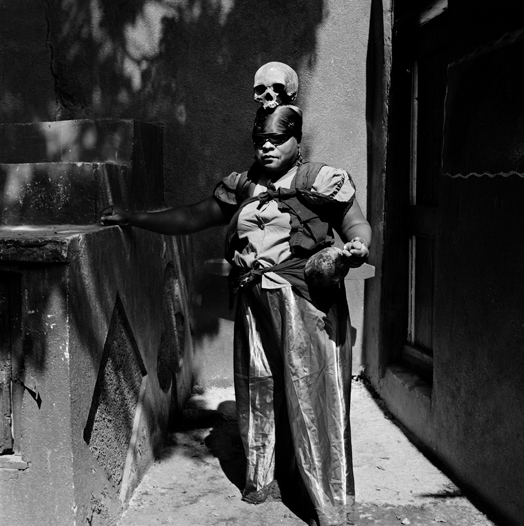
'Woman possessed by Gede' (Lambda print) 40 x 40 cm, (2010) Ed 5

LEAH GORDON
THE SUNDAY TIMES: AUGUST 2010
LEAH GORDON REVIEW
by WALDEMAR JANUSZCZAK
THE SUNDAY TIMES: AUGUST 2010
LEAH GORDON REVIEW
by WALDEMAR JANUSZCZAK
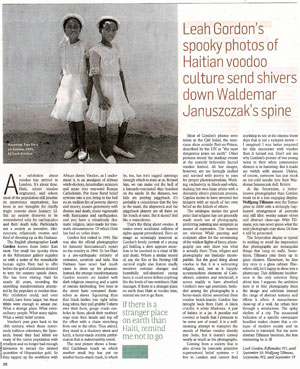
Click on image to read the article
Download 300dpi image for press and online use
Click here to download book
Download Leah Gordon biography
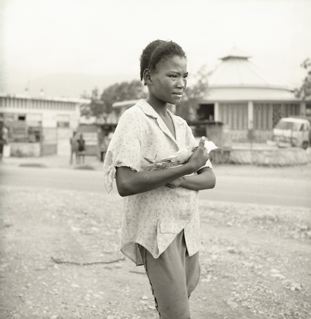
LEAH GORDON:
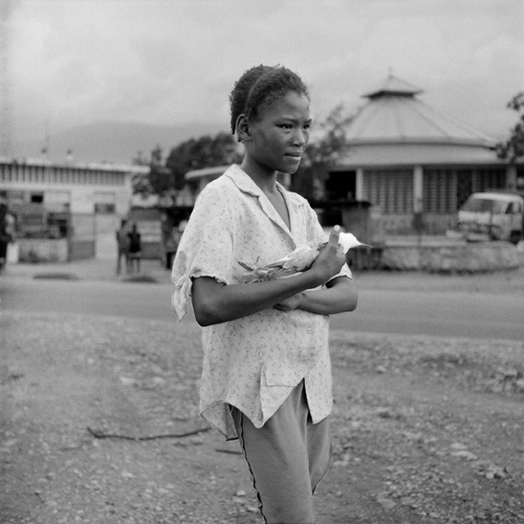
'Girl with Dove' Haiti 1993
Platinum print, 100 x 100cm, unique
"Working exclusively in black and white - all her images are lovingly crafted and scented with poetry"
Sunday Times review (1.8.2010) by Waldemar Januszczak
Leah Gordon is a photographer, film-maker and curator and has produced a body of work on the representational boundaries between art, religion, anthropology, post-colonialism and folk history.
In the twenty years that she has been working as a curator/artist in Haiti she has produced a number of films including 'Bounda pa Bounda' about a cross-dressing Vodou priest and 'Atis Rezistans: the Sculptors of Grand Rue' about a collective of artists in Port-au-Prince. Her photography book 'Kanaval: Vodou, Politics and Revolution on the Streets of Haiti' was published in June 2010 and was the culmination of a sixteen year long project.
Gordon was the adjunct curator for the Haitian Pavilion at the 54th Venice Biennale, is on the curatorial team for the 'In Extremis' show of Haitian Vodou arts which opens in Sept 2012 at the Fowler Museum, UCLA and is co-curating, with Alex Farquharson, a major show, Kafou, on Haitian art, Vodou and the Revolutionary History at the Nottingham Contemporary in October 2012. Her photographic work registers Haiti's juncture between its history, its cosmology and the present. Gordon is represented by Riflemaker Gallery, London.
Download 300dpi image for press and online use
Click here to download book
Download Leah Gordon biography
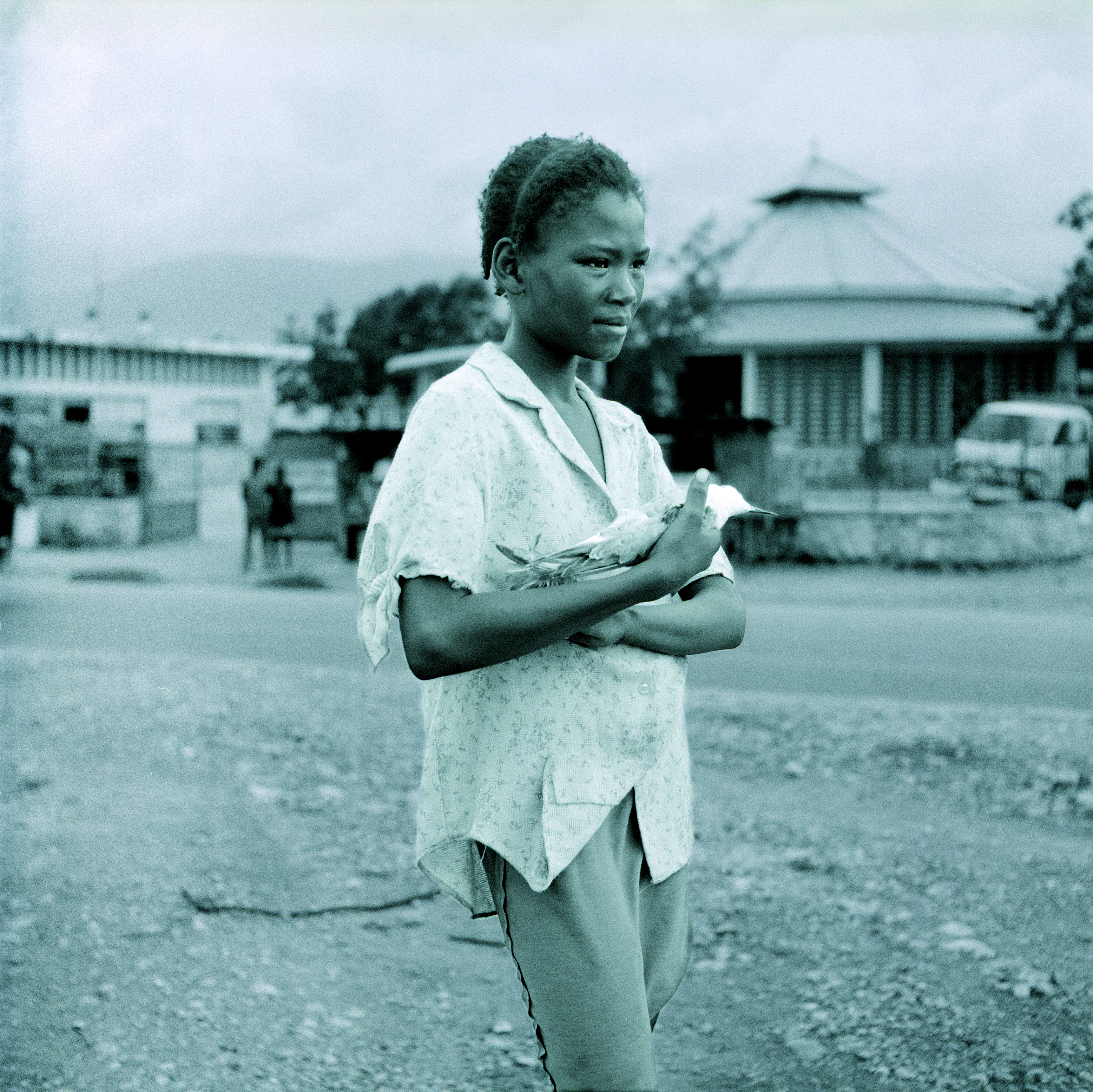
LEAH GORDON:
'Girl with Dove' Haiti 1993
Platinum print, 100 x 100cm, unique
"Working exclusively in black and white - all her images are lovingly crafted and scented with poetry"
Sunday Times review (1.8.2010) by Waldemar Januszczak
Leah Gordon is a photographer, film-maker and curator and has produced a body of work on the representational boundaries between art, religion, anthropology, post-colonialism and folk history.
In the twenty years that she has been working as a curator/artist in Haiti she has produced a number of films including 'Bounda pa Bounda' about a cross-dressing Vodou priest and 'Atis Rezistans: the Sculptors of Grand Rue' about a collective of artists in Port-au-Prince. Her photography book 'Kanaval: Vodou, Politics and Revolution on the Streets of Haiti' was published in June 2010 and was the culmination of a sixteen year long project.
Gordon was the adjunct curator for the Haitian Pavilion at the 54th Venice Biennale, is on the curatorial team for the 'In Extremis' show of Haitian Vodou arts which opens in Sept 2012 at the Fowler Museum, UCLA and is co-curating, with Alex Farquharson, a major show, Kafou, on Haitian art, Vodou and the Revolutionary History at the Nottingham Contemporary in October 2012. Her photographic work registers Haiti's juncture between its history, its cosmology and the present. Gordon is represented by Riflemaker Gallery, London.